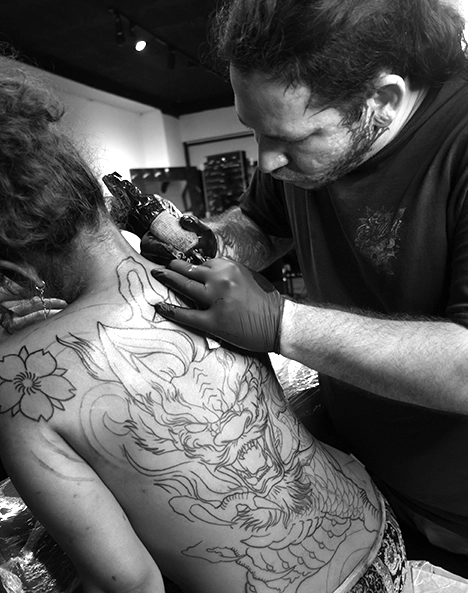
After years of tattooing clients from across the Americas and Europe, we’ve heard every myth in circulation. Some are harmless misconceptions. Some actively lead people to make bad decisions about their tattoos. Here’s our honest take on the most common ones.
Myth 1: «Tattoos will stretch if you gain weight»
Partially true — but rarely as dramatic as people fear.
Skin does stretch with significant weight changes, and tattoos can distort. But for most people with moderate weight fluctuation (under 30–40 lbs), the effect on a well-placed tattoo is minimal. The areas most affected are the abdomen, upper arms, and thighs. Areas like the forearm, back, and calves are much more stable. Pregnancy can significantly affect abdominal tattoos, which is why most artists recommend waiting until after you’re done having children before tattooing that area.
Myth 2: «Dark skin can’t hold color tattoos»
False — but the approach is different.
Tattoos on darker skin tones absolutely hold color. The key is an artist who understands how pigment interacts with more melanin-rich skin. Certain colors — particularly yellow, light pink, and very light pastels — will show less vibrantly on darker skin. But bold colors like red, blue, green, and especially black work beautifully. The myth that dark skin «can’t do color» comes from artists who don’t have experience with diverse skin tones, not from any property of the skin itself.
Myth 3: «You should shave the area before your appointment»
Don’t do this.
Let your artist shave the area. They use the right tools for the job and can assess the skin properly. Self-shaving before an appointment often causes minor nicks and irritation that can complicate the tattooing process. Just arrive with clean, moisturized skin and let us handle the prep.
Myth 4: «Tattoos in certain places hurt less if you’re heavier»
False.
Pain in tattooing is primarily determined by proximity to bone and nerve density, not by body composition. The rib cage, spine, shins, and inner arms hurt in the same relative way regardless of body fat. If anything, areas with more fat can sometimes be more sensitive because the skin is stretched differently.
Myth 5: «You can’t donate blood if you have tattoos»
No longer true in most countries — there’s just a waiting period.
In the United States and most of Europe, the waiting period to donate blood after a tattoo from a licensed studio is typically 3 months (the US Red Cross updated its guidelines in recent years). Getting a tattoo at a properly licensed and regulated studio — like Pangea Ink — means this waiting period is minimal and standardized. Unlicensed or informal tattoo work carries higher infection risk, which is why the waiting period exists in the first place.
Myth 6: «White ink tattoos stay white»
Partially true — and usually disappointing over time.
White ink tattoos look striking when fresh. Over time, they tend to yellow or fade into a subtle raised texture rather than a visible design. They also show differently on different skin tones. White works best as a highlight element within a larger piece, or as UV/blacklight reactive ink on very light skin. As a standalone tattoo style, white ink is one of the most ephemeral choices you can make.
Myth 7: «Cheaper tattoos are just as good as expensive ones»
This is the myth that costs people the most money long-term.
An $80 tattoo from an uncertified artist costs significantly more than $80 once you factor in touch-up work, potential infection treatment, and eventual laser removal or cover-up by a skilled artist charging $200/hour. Quality tattoo work is expensive because experienced artists are expensive. The price difference between a skilled artist and a cheap one exists for real reasons that show up in your skin five years from now.
Myth 8: «Drinking before a tattoo helps with the pain»
Absolutely do not do this.
Alcohol thins the blood, which causes excessive bleeding during the session. This isn’t just a health concern — it physically affects the quality of the tattoo because the excess blood in the skin makes it harder for the artist to see the work clearly and for the ink to settle properly. Any artist worth working with will refuse to tattoo someone who has been drinking. Come sober, hydrated, and well-fed.
Myth 9: «Tattoos are permanent — there’s no going back»
Mostly true, but laser removal technology has improved significantly.
Modern laser tattoo removal has become genuinely effective, particularly for black ink. Colored inks — especially green and yellow — are more resistant to removal. Complete removal typically requires 5–15 sessions and is expensive. It’s also time-consuming (sessions are spaced weeks apart to allow healing). «Permanent» remains the right way to think about tattoos for decision-making purposes, but «truly irremovable» is less accurate than it used to be.
Myth 10: «Sun exposure fades tattoos — but only old ones»
False. UV exposure fades tattoos regardless of age.
UV radiation breaks down pigment molecules in tattoo ink at every stage — fresh, healing, or 20 years old. The damage is cumulative. Keeping tattoos protected with SPF 50+ when they’re exposed to sun is one of the single most effective things you can do to preserve the quality of your work over time. This applies to black ink just as much as to color work.
Have a question about something you’ve heard about tattoos? Drop us a message on WhatsApp — we’d rather you ask us than make a decision based on bad information.