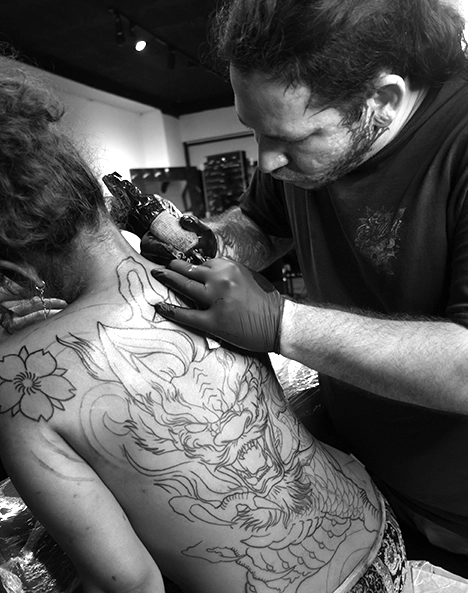
The full back is the most dramatic tattoo canvas the human body has to offer. It’s where artists go when they want to create something without limits — sweeping landscapes, massive portraits, intricate mandalas, or full narrative scenes that tell a complete story from shoulder to hip.
At Pangea Ink, full back pieces are among the most significant projects we undertake — and among the most rewarding. Here’s how to think about planning yours.
What Counts as a «Full Back» Tattoo?
A full back tattoo covers the entire posterior torso — from the base of the neck to just above the tailbone, and across to both sides of the torso. This includes:
- Upper back and shoulder blades
- The spine and mid-back
- Lower back
- Side panels (often extending around to the ribs)
Many full back tattoos start as partial pieces that expand — an upper back piece that grows down, or a shoulder piece that eventually consumes the entire back. This is a completely valid approach, and often results in more organic compositions than trying to plan the entire piece at once.
How Long Does a Full Back Tattoo Take?
A full back piece with significant detail — shading, color, or complex imagery — will typically require 20–40 hours of tattooing spread across multiple sessions. The range depends on the style:
- Full blackout back: 15–25 hours, 2–3 sessions
- Blackwork with detail: 25–40 hours, 3–5 sessions
- Hyperrealism or color realism: 30–50 hours, 4–6 sessions
- Japanese traditional (full back irezumi): Often 50–100+ hours over years
At Pangea Ink, most international clients doing full back pieces plan 2–4 sessions per visit, with multiple visits if doing a highly detailed piece. We build the schedule around your timeline and the work.
The Design Process for a Full Back
The design phase is where a full back piece succeeds or fails. A composition that looks good in a sketch may not flow correctly across the curves and contours of a real back. Good artists design specifically for the body — accounting for how the shoulder blades move, how the spine affects centerline symmetry, and how the piece will read from a distance vs. up close.
Our process:
- Concept consultation — we discuss your vision, references, and the style direction
- Custom design — our artists create a piece designed specifically for your body
- Stencil placement — before any ink, we test the layout on your actual back
- Session planning — we sequence the work so the most important focal elements are done in the first session
What a Full Back Piece Costs
This is where the numbers become significant. At top studios in the United States or United Kingdom, a full back piece from a specialist artist runs $15,000–$40,000 or more depending on the artist’s rate and the complexity of the design.
At Pangea Ink, our Full Canvas package — which includes the tattoo work, premium hotel accommodation, airport transfers, and curated city experiences — starts from $10,000. For many international clients, the entire Panama trip including flights, hotel, and tattoo costs less than the tattoo alone would at home.
Healing and Aftercare for a Full Back
A back tattoo heals differently from arm or leg work — you can’t see it easily, you sleep on it, and clothing constantly rubs against it. Practical aftercare tips:
- Sleep on clean cotton sheets — change them every day for the first week
- Wear loose-fitting, breathable tops (nothing tight against the fresh tattoo)
- Have someone help you apply lotion — it’s impossible to reach your full back alone
- Avoid pools, the ocean, and intense exercise for 2–3 weeks minimum
We provide a full aftercare kit with every tattoo, and our team is available via WhatsApp throughout your healing process — whether you’ve just left Panama or you’re healing the piece at home months later.
Start Planning Your Full Back
A full back piece is a long-term relationship between you and your artist. It takes trust, planning, and multiple sessions. We take very few full back bookings per year — which is why we encourage reaching out early.
Contact us with your concept and timeline, and we’ll start the conversation.